


2026 Toyota 4Runner: 16 Builds, Gas or Hybrid

The 2026 Toyota 4Runner is a body-on-frame midsize SUV sold in 16 configurations, from a $41,370 rear-drive SR5 to a $68,200 TRD Pro at launch. Every one uses the same 2.4-liter turbocharged 4-cylinder, either as the i-FORCE gas engine or as the i-FORCE MAX hybrid, and the range covers 278 to 326 horsepower. For a Central Indiana buyer the real forks are 2: four-wheel drive or not, and how much trail hardware you actually need under a vehicle that will spend most of its life on pavement. Our 4Runner inventory shows which builds are here now.

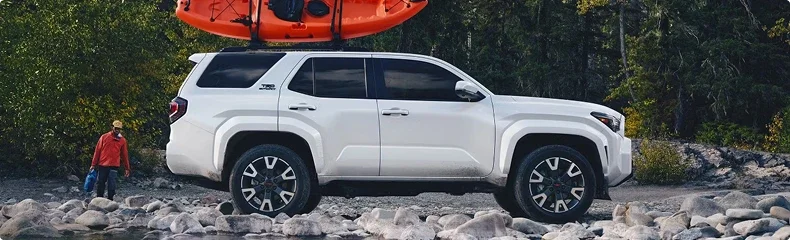
White Toyota 4Runner carrying kayaks on its roof rack, parked on a rocky riverbank

4Runner at a Glance

2026 Toyota 4Runner Specification
MSRP at launch $41,370 to $68,200
Configurations 16, across 12 trims
Engine 2.4-liter turbocharged i-FORCE, or i-FORCE MAX hybrid
Output 278 to 326 hp; 317 lb-ft gas, 465 lb-ft hybrid
Drive Rear-wheel drive or four-wheel drive
Seating 5 standard on every build; a third row is optional on the SR5 and the Limited
Cargo 48.4 cu ft behind the rear seats and 90.2 maximum on the 10 gas builds; 42.6 and 82.6 on the 6 hybrids
Towing 6,000 lb on most trims, 5,800 lb on 3
Safety Toyota Safety Sense 3.0 standard

MSRP at launch (2026 model year), excluding destination.

Silver Toyota 4Runner climbing a snow-dusted forest trail, seen from behind

Trims and Prices

Twelve trims, 16 builds. Four-wheel drive costs $2,500 on the SR5 and $2,000 on the other 3 trims that offer it, and the hybrid is a four-wheel-drive proposition only.

Build MSRP at Launch Drive Engine Best For
SR5 $41,370 Rear Gas The entry point, and the value end of the range
SR5 $43,870 4x4 Gas The same truck with the transfer case
TRD Sport $48,350 Rear Gas Street-tuned looks and suspension
TRD Off-Road $50,290 4x4 Gas Where the real trail hardware begins
TRD Sport $50,350 4x4 Gas Sport trim, four-wheel drive
TRD Off-Road i-FORCE MAX $53,090 4x4 Hybrid Trail hardware plus the hybrid's torque
TRD Sport Premium $53,710 Rear Gas Sport trim with the 14-inch screen
TRD Sport Premium $55,710 4x4 Gas The same, with four-wheel drive
TRD Off-Road Premium $56,070 4x4 Gas Trail hardware with the upgraded cabin
Limited $56,500 Rear Gas Road-biased comfort, rear drive
Limited $58,500 4x4 Gas Road-biased comfort, four-wheel drive
TRD Off-Road Premium i-FORCE MAX $58,870 4x4 Hybrid The well-equipped trail hybrid
Limited i-FORCE MAX $61,300 4x4 Hybrid Comfort and the hybrid powertrain
Platinum i-FORCE MAX $63,960 4x4 Hybrid The luxury end of the range
Trailhunter i-FORCE MAX $68,000 4x4 Hybrid Overlanding, built at the factory
TRD Pro i-FORCE MAX $68,200 4x4 Hybrid The most capable 4Runner Toyota builds

MSRP at launch (2026 model year), excluding destination. Destination, processing and handling adds $1,595.

Two things about that ladder run against expectation. The trail hardware starts at TRD Off-Road, not at TRD Sport, which is a street-suspension trim wearing sportier clothes; the separation shows up in the approach and departure angles, not in ride height, where the base TRD Off-Road actually sits lower. And the 5 most expensive builds are hybrid only, so anyone shopping at the expensive end has already made the powertrain decision without noticing.

Deals move month to month across the lineup, and the current new Toyota specials show what is running now. You can also start a financing application or get a figure on your trade before you come in.

Overhead view of a silver Toyota 4Runner parked at a wooded climbing spot as climbers gear up nearby

Gas or Hybrid

Both engines are the same 2.4-liter turbocharged inline 4-cylinder. What separates them is torque and where they sit in the range.

  • i-FORCE gas: 317 lb-ft. Offered on the SR5, both Sport trims, both non-hybrid Off-Road trims and the Limited.
  • i-FORCE MAX hybrid: 465 lb-ft, which is 148 lb-ft more. Optional on TRD Off-Road, TRD Off-Road Premium and Limited, and the only engine on Platinum, Trailhunter and TRD Pro.
  • Across both: 278 to 326 horsepower.

Where you can choose, the hybrid costs a flat $2,800: on the TRD Off-Road, on the Off-Road Premium and on the Limited alike. The torque is the point, not the horsepower. A 465 lb-ft figure is what makes a heavy body-on-frame vehicle feel unhurried pulling a trailer or climbing out of a rutted lane, and it arrives lower in the rev range than a gas engine's peak does.

Our hybrid inventory lists the i-FORCE MAX builds alongside the rest of the hybrid range.

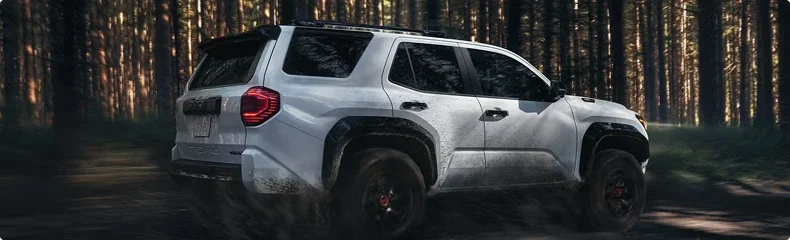
White TRD Pro 4Runner with a roof rack moving at speed along a forest track

Fuel Economy

  • Rear-wheel drive, gas: 20 city, 24 to 26 highway, 22 combined.
  • Four-wheel drive, gas: 19 to 20 city, 24 to 25 highway, 21 combined.
  • Four-wheel drive, hybrid: 22 to 23 city, 24 highway, 23 combined.

Everything runs on regular fuel from a 19.0-gallon tank. The hybrid is the most efficient 4Runner as well as the strongest one, which is the opposite of how the choice usually goes on a body-on-frame vehicle. The gap over a gas 4x4 is 2 MPG combined, which is real but modest, so buy the hybrid for the 465 lb-ft rather than for the fuel bill.

Red Toyota 4Runner parked on a rocky lakeshore beside a travel trailer as a family walks by

Towing

Trims Maximum Towing
SR5, both Sport trims, both Off-Road trims, Limited, and the hybrid versions of those 6,000 lb
Platinum, Trailhunter, TRD Pro 5,800 lb

The top 3 trims tow slightly less than the ones below them, which runs against the assumption that the rating climbs with the price. It does not. If towing is the job, an SR5 does it as well as a Trailhunter, and at launch it cost about $26,600 less.

Weigh a trailer loaded, with fuel and water and gear aboard, not at its advertised dry weight, and check that figure against the rating on the exact vehicle.

Dark green Toyota 4Runner with a roof rack working down a snow-covered mountain track

Space and Dimensions

Measurement 2026 4Runner
Length 194.9 in
Width 78.0 to 79.9 in
Height 72.6 to 74.0 in
Wheelbase 112.2 in
Ground clearance 8.1, 8.8, 9.1 or 10.1 in, by build
Approach / departure angle 18/22 degrees on most builds, 19/24 on the TRD Off-Roads, 33/24 on Trailhunter and TRD Pro
Leg room, front / rear 41.8 / 34.8 in
Cargo behind the rear seats 48.4 cu ft on the gas builds, 42.6 on the hybrids
Maximum cargo 90.2 cu ft on the gas builds, 82.6 on the hybrids
Curb weight 4,455 to 5,500 lb
Fuel tank 19.0 gal

Every 4Runner seats 5. A 50/50 split fold-flat third row is a factory option on 4 builds only, the SR5 and the Limited in either drive, and it suits small children and short trips, not adults on a long drive. Order it and cargo changes with it: those builds carry 44.8 cu ft behind the second row and 12.1 behind the third. No TRD trim, no Platinum, no Trailhunter, no TRD Pro and no hybrid can be had with it at all.

Rear leg room is 34.8 inches across the whole range, which is the honest answer to whether an adult sits comfortably behind another adult. It is tight, and it does not improve as you climb the price ladder.

Ride height does not climb steadily with price either, and the order surprises people:

Ground clearance Builds
8.1 in SR5 4x2, SR5 4x4, TRD Off-Road
8.8 in TRD Sport 4x2, TRD Sport 4x4, Limited 4x2, Limited 4x4, Limited i-FORCE MAX, Platinum
9.1 in TRD Sport Premium 4x2, TRD Sport Premium 4x4, TRD Off-Road i-FORCE MAX, TRD Off-Road Premium, TRD Off-Road Premium i-FORCE MAX
10.1 in Trailhunter, TRD Pro

The base TRD Off-Road has the least clearance of any 4Runner, less than the road-biased TRD Sport. Clearance is not what makes it the trail trim; the angles are. It approaches at 19 degrees and departs at 24, against the Sport's 18 and 22. The 2 builds above them depart at the same 24 but approach at 33, and those extra 14 degrees are what let a vehicle start up a steep bank without the front bumper touching first.

4Runner dashboard and wide touchscreen seen from the passenger side, with woodland through the windshield

Screens and Audio

Feature Where It Lands
8-inch Audio Multimedia Display, 8 speakers plus a roof Exciter, wireless Apple CarPlay and Android Auto compatibility Standard on SR5, TRD Sport, TRD Off-Road and the hybrid TRD Off-Road
14-inch Audio Multimedia Display with 14-speaker JBL Premium Audio and the JBL FLEX portable Bluetooth speaker Standard on both Premium trims, Limited, Platinum, Trailhunter and TRD Pro, in gas and hybrid form
7-inch color Multi-Information Display gauge cluster SR5 only; every other grade gets a 12.3-inch digital cluster

Three details in that table are easy to miss:

  • The roof Exciter on the 8-inch system is a transducer built into the headliner, so the standard audio is doing more than 8 speakers suggests.
  • The JBL FLEX is a portable Bluetooth speaker that lives in the dash and comes out with you, which is a different thing entirely from a fixed stereo when the vehicle is parked at a campsite or a trailhead.
  • The gauge cluster does change as you move up. The SR5 keeps a 7-inch color Multi-Information Display; every grade above it runs a 12.3-inch digital cluster, which is easy to overlook when you are comparing numbers and obvious the moment you sit in one.
Driver reaching to the 4Runner touchscreen while it displays a navigation map

Packages Worth Knowing

Package or option What it does Where it lands
Tow Tech Package A digital rearview mirror, an integrated trailer brake controller and Trailer Backup Guide Limited, Platinum, Trailhunter, TRD Pro, both Premium off-road trims, TRD Sport Premium
Stabilizer Disconnect Mechanism Disconnects the front stabilizer bar for more wheel travel on rough ground, then reconnects for the road TRD Off-Road Premium i-FORCE MAX
Four prewired auxiliary switches Saves wiring work if you add lights, a compressor or a winch TRD Off-Road i-FORCE MAX and TRD Off-Road Premium i-FORCE MAX
Digital Key Unlocks and starts the vehicle from a phone, so a second driver can be given access without handing over a fob Limited, Limited i-FORCE MAX, Trailhunter, TRD Pro

The trailer brake controller in that first row is the one that matters if what you pull has brakes of its own. We can walk through any of these on the vehicle itself, and our genuine Toyota accessories cover most of what people add afterward.

Climber loading a helmet and rope into the open cargo area of a Toyota 4Runner in a forest

Safety

  • Toyota Safety Sense 3.0: standard on every build. It carries a pre-collision system with pedestrian detection, lane tracing assist, full-speed radar cruise control, lane departure alert with steering assist, automatic high beams, road sign assist and proactive drive assist.
  • Blind Spot Monitor with Rear Cross-Traffic Alert and Trailer Merge Warning: the trailer function is the useful extra, because a blind spot system that accounts for what you are pulling is a different tool from one that does not.
  • Front and Rear Parking Assist with Automatic Braking and Pedestrian Detection: it watches for obstacles and for people at parking speeds and can brake on its own, which counts for more in a vehicle with this much body behind the driver.
  • Panoramic View Monitor with 360-degree Overhead View and Curb View: the curb view is what saves a wheel on a trail edge or a parking block.
  • NHTSA overall rating: 4 stars.
Close-up of a mud-caked black TRD alloy wheel and all-terrain tire on a 4Runner

Warranty

Coverage Term
Basic 36 months or 36,000 miles
Powertrain 60 months or 60,000 miles
Corrosion 60 months, unlimited miles
i-FORCE MAX hybrid system 96 months or 100,000 miles
Hybrid battery 120 months or 150,000 miles

The corrosion term is the one that counts most on an Indiana vehicle, because it is the only coverage with no mileage cap at all, and because a body-on-frame SUV has a frame under it that spends every winter in salt.

Red Toyota 4Runner with its tailgate open outside a house as a family and their dog walk up

Driving It Here

Most 4Runners here in Central Indiana do ordinary things, and the trail hardware earns its keep a few days a year.

The ordinary miles are commuting. Hamilton County sends about 56,000 residents into Marion County, roughly a quarter of its workforce, and the average one-way trip from ZIP 46060 runs 27 minutes down State Road 37, US 31 or I-69. That is the better part of an hour a day in a body-on-frame vehicle, which is the real argument for the Limited or a Premium trim over a TRD Off-Road that will rarely leave pavement.

The winter miles are the case for four-wheel drive, and the reason is ice more than depth. Central Indiana sits near the rain and snow line, so freezing rain and freeze-thaw shape a morning more than accumulation does. Normal snowfall is 25.5 inches a year, and roughly 27 days see a high at or below freezing. The state answers both with brine before a storm and salt after it.

The clearance question is a water question here more than a rock question. The county is flat and drains slowly on the Tipton Till Plain. After heavy rain, Noblesville closes named roads for standing water:

  • 186th Street between State Road 37 and Promise Road
  • Olio Road between 146th and 156th
  • Mill Creek Road between State Road 32 and Stonehenge Boulevard
  • Promise Road between 181st and 186th
  • Riverwood Avenue

That is the local case for 10.1 inches of clearance over 8.1.

The trail miles do exist. Strawtown Koteewi Park runs to more than 800 acres on the White River and is the largest park in Hamilton County. A 4Runner is more vehicle than most weekends require, and the people who buy one usually know that and want it anyway.

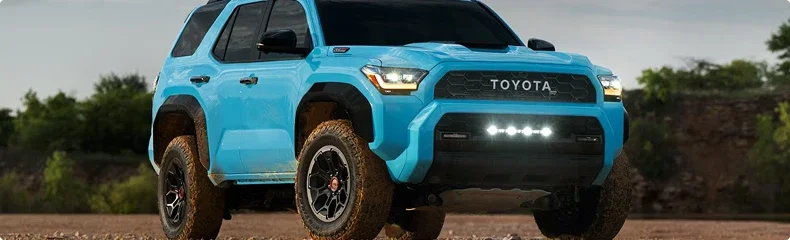
Bright blue TRD Pro 4Runner with a light bar and all-terrain tires on open ground

Which Trim Should You Choose

Which trim you land on depends on how many of those trail days you really have.

  • The value pick: SR5. It tows the full 6,000 pounds, carries Toyota Safety Sense 3.0 like everything above it, and at launch it undercut the TRD Pro by about $26,800.
  • The all-weather pick: SR5 4x4. Four-wheel drive for $2,500, with nothing else changed.
  • The trail pick: TRD Off-Road. This is where the hardware starts. The 4x4 TRD Sport sits $60 above it and is the street-tuned trim, which is the wrong way round from what the badges suggest.
  • The torque pick: any i-FORCE MAX. It costs $2,800 where you have the choice and buys 465 lb-ft, which is what a heavy vehicle wants when it is loaded.
  • The daily-driver pick: Limited. Road-biased, the 14-inch screen and the JBL system standard, and still rated to tow 6,000 pounds.
  • The everything pick: Trailhunter or TRD Pro. Both are hybrid, both sit at the top of the range, and both are more vehicle than a Hamilton County winter requires. That is the point of them: the 33-degree approach angle and the 10.1 inches of clearance are bought for the trips you take twice a year, not the ones you take twice a day.

Frequently Asked Questions

At launch, from $41,370 for a rear-drive SR5 to $68,200 for the TRD Pro, before a $1,595 delivery, processing and handling fee. Equipment changes what an individual vehicle costs, so the figure that counts is the one on its own listing in our inventory.

6,000 pounds on most trims, including the SR5 at the bottom of the range. The Platinum, Trailhunter and TRD Pro are rated slightly lower at 5,800 pounds, so the rating does not climb with the price.

It costs $2,800 on the 3 trims where you have a choice. What it buys is 465 lb-ft of torque against 317 for the gas engine, and about 2 MPG combined. Buy it for the torque, which is what a heavy vehicle wants when it is towing or loaded, rather than for the fuel saving.

Five, on every build. A 50/50 split fold-flat third row is an option on 4 of the 16, the SR5 and the Limited in rear-wheel or four-wheel drive, and it takes those to 7. No TRD trim, no Platinum, no Trailhunter, no TRD Pro and no hybrid offers it. Where it is fitted, treat it as occasional seating: fine for a short run across town with 2 extra kids aboard, cramped for anything longer.

On the 10 gas builds, 48.4 cu ft behind the rear seats and 90.2 cu ft with them folded. All 6 hybrids hold 42.6 and 82.6 instead, because the battery takes part of the load floor. Adding the optional third row changes it again, to 44.8 behind the second row and 12.1 behind the third.

Suspension and intent, not price order. The TRD Sport is the street-tuned trim and the TRD Off-Road carries the trail hardware, even though the gas TRD Off-Road sits just below the four-wheel-drive TRD Sport in the price table above, by $60. If the trail is the point, the Off-Road is the one.

Between 8.1 and 10.1 inches, and it varies by build in a way the price does not predict. The full breakdown sits in the dimensions table above. In Central Indiana that spread matters most for standing water on flooded county roads, not for rock crawling.

A 2.4-liter turbocharged inline 4-cylinder, in 2 forms. The i-FORCE gas version makes 317 lb-ft and the i-FORCE MAX hybrid makes 465 lb-ft. Across the range the output runs from 278 to 326 horsepower, and everything takes regular fuel.

No. The SR5, TRD Sport, TRD Sport Premium and Limited are offered in rear-wheel drive. Four-wheel drive adds $2,500 on the SR5 and $2,000 on the other 3. Every off-road trim and every hybrid is four-wheel drive only.

A digital rearview mirror, an integrated trailer brake controller and Trailer Backup Guide. It is offered on the Limited, Platinum, Trailhunter, TRD Pro, both Premium off-road trims and the Sport Premium. The brake controller is the part that matters if your trailer has brakes.

Yes, Toyota Safety Sense 3.0 on every build, with a pre-collision system with pedestrian detection, lane tracing assist, radar cruise control, lane departure alert with steering assist, automatic high beams, road sign assist and proactive drive assist. Blind Spot Monitor with Rear Cross-Traffic Alert adds Trailer Merge Warning.

For 120 months or 150,000 miles, whichever comes first. The hybrid system itself is covered for 96 months or 100,000 miles, and both run well past the 60-month, 60,000-mile powertrain term.

Offers change month to month, so the live list is the place to look. See the current new Toyota specials running across the Toyota lineup at the moment.